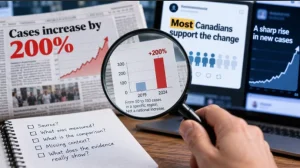
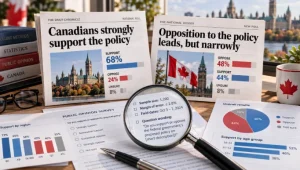
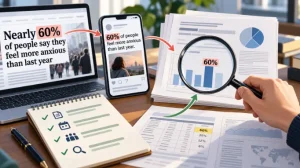
A calm, practical method for reading the news online — lateral reading, the SIFT moves, the marks of a credible report, and a quick check to run before you ever hit share.
How to spot fake news is no longer a niche concern for journalists — it is an everyday skill, because the old gatekeepers are gone. A generation ago, most news passed through editors and standards before it reached you. Today anything can reach your feed in seconds, true or false, and it is on each of us to tell the difference.
The good news is that you do not need to be an expert to do this well. Research into how professional fact-checkers work found they share a few simple habits that ordinary readers can copy — and that those habits beat gut instinct and surface impressions every time. In one well-known study, people judged a website’s trustworthiness largely by how polished it looked, and were fooled; trained fact-checkers, by contrast, barely glanced at the page before leaving it to see what the rest of the web said about it.
That single move — leaving the page to check the source elsewhere — is called lateral reading, and it sits at the heart of everything on this page. A few terms are worth getting straight first. Misinformation is false information shared without intent to deceive; someone simply got it wrong and passed it on. Disinformation is false information created and spread deliberately to mislead. You do not always need to know which you are looking at — the checks below work on both.
It also helps to drop the idea that only gullible people fall for false stories. Everyone is vulnerable, because the weakness being exploited is universal: we are quicker to believe things that fit what we already think, and quicker still to share things that make us feel something. That pull is called confirmation bias, and it does not care how educated or sceptical you are. The most dangerous moment is not when a stranger tells you something implausible — it is when a friend shares something that confirms exactly what you already suspected. Knowing that about yourself is half the defence; the checks on this page are the other half.
SIFT is a short, widely taught routine for checking anything online. You do not have to use every move on every item — often the first one settles it. Think of them as reflexes, not a checklist to grind through.
Notice your reaction. If something makes you angry, smug or desperate to share, that is exactly the moment to pause — strong emotion is how false content spreads.
Before you read, find out who is behind it. Open a new tab, search the outlet or author, and see whether they have a track record of accuracy.
Look for other reputable outlets reporting the same thing. If a big claim appears in only one obscure place, treat it with real caution.
Follow quotes, studies and images back to their source. So much online content is clipped, recycled or stripped of the context that changes its meaning.
Two small habits make SIFT faster. The first is click restraint: scan the whole page of search results before clicking, rather than trusting the top link. The second is opening tabs freely — checking a source is easier when you can hold the original and your research side by side. Done well, the whole thing takes about thirty seconds.
Here is how it feels in practice. Say a dramatic post crosses your feed: “Study proves [some alarming claim].” You Stop, because it made your pulse jump. You Investigate by searching the site’s name — and find it is three weeks old, with no staff listed and no other articles. You Find better coverage by searching the claim itself, and notice that no established outlet mentions it at all. That absence is itself an answer. Finally you Trace: there is a “study,” but the link goes nowhere and no institution is named. Thirty seconds in, you have learned enough to move on without ever arguing with the article line by line.
Tick every signal the article or site genuinely shows. The more it has, the stronger its credibility signals — though no checklist is proof. Use it to decide whether a source is worth your trust or your lateral read.
These are signals, not a verdict. A polished site can still be wrong, and a plain one can be excellent — which is why you always finish with a lateral read.
Most of us read vertically: we land on a page and scroll down it, judging the whole thing by the page itself — its design, its confident tone, its logo. The trouble is that anyone can build a slick page and claim anything on it. Appearances tell you almost nothing about whether to trust a source.
Fact-checkers read laterally instead. Within seconds of landing on an unfamiliar site, they leave it — opening new tabs to ask what other, independent sources say about this outlet, this author, this claim. They let the wider web judge the page rather than letting the page judge itself. It feels counter-intuitive the first time, but it is faster and far more reliable than reading every word and arguing with yourself.
Practically, that means three quick questions, each answered in another tab: Who is behind this? What do others say about them? Is the specific claim reported anywhere credible? If the answers are reassuring, read on. If they are thin, empty or alarming, you have your answer before you have wasted a minute on the content itself.
Working notes on verification, media literacy and reading the news well. Read the blog →
A website advertises a one-in-ten chance of winning. A promotional contest promises thousands of prizes. An online game describes its outcomes as random or independently verifiable.…
Trustworthy journalism tends to wear its workings on the outside. None of these guarantees a story is right, but together they are the hallmarks of a newsroom that takes accuracy seriously.
A named journalist and a clear publication date mean someone is accountable for the work, and you can tell whether it is current.
Credible reports attribute claims — named people, documents, data — and link out so you can check the evidence yourself.
Good outlets label opinion, analysis and sponsored content clearly, so you always know whether you are reading reporting or argument.
Everyone makes mistakes; serious outlets fix them in the open and say so. A visible corrections record is a sign of good faith, not weakness.
Fair reporting gives the people it criticises a chance to respond. A one-sided piece with no reply sought is a yellow flag.
An honest outlet is open about ownership and funding, because who pays for the news can shape what gets covered and how.
These standards are not new — they are the same principles that press and media standards bodies have long encouraged through voluntary codes of practice: accuracy, fairness, a clear line between fact and comment, and a willingness to correct the record. You do not need a council to apply them; you can hold every article you read to exactly this bar.
No single flag proves a story false, but the more you see, the harder you should look before believing — and certainly before sharing.
Content designed to make you furious or frightened is built to be shared, not to inform. Strong emotion is the single biggest tell.
“Scientists say” with no study, no name and no date is not evidence. Vagueness where specifics should be is a warning.
Fake sites mimic real outlets with a tweaked spelling or an odd ending. Always check the actual domain, not just the logo.
Real images are constantly recycled into unrelated events. A reverse image search often unmasks this in seconds.
An explosive claim that no reputable outlet has touched is far more likely to be false than a world exclusive you happened to find.
If the headline is dramatic but the article walks it back — or does not support it at all — the goal was your click, not your understanding.
The most common visual deception is not a clever fake — it is a real photo or video used in the wrong place. An image from one event, one country or one year gets attached to another, and the lie is in the caption, not the picture. The fix is a reverse image search: ask a search engine where else that image has appeared, and you will often find its true origin in seconds.
Manipulated and AI-generated media are a growing challenge, and the tools to detect them are still catching up. For now, treat extraordinary images with the same caution as extraordinary claims: look for the original, check whether reputable outlets are using it, and be wary of anything that arrives with no source and a strong emotional charge. Odd hands, garbled text in the background and lighting that does not quite add up remain useful tells for synthetic images.
Video deserves the same suspicion as images, and a little more patience. Clips are routinely shortened to cut out the context that would change their meaning, slowed down or sped up to make someone look impaired or frantic, and re-captioned to invent a story that never happened. Before you believe a viral clip, ask the familiar questions: who first posted it, when, and has any reputable outlet verified where and when it was actually filmed? Often the fuller, original video — which tells a very different story — is only a search away.
The principle behind all of it is the same lateral move: do not judge the clip by the clip. Leave it, find out where it really came from, and let independent coverage tell you whether it means what the caption claims.
One of the most useful habits you can build is separating bias from falsehood. They are not the same thing, and treating them as the same leads people either to trust nothing or to dismiss anything they disagree with as “fake.”
Every outlet makes choices — what to cover, whom to quote, which words to use, where a story sits on the page. That is perspective, and it exists even in careful, honest journalism. A report can be accurate and fair while still reflecting a worldview. Recognising an outlet’s leanings helps you read it wisely; it does not, by itself, make the facts in it false.
Falsehood is different: it is a claim that is simply not true, regardless of anyone’s politics. The way to handle bias is not to retreat to sources that only flatter your existing views — that is how echo chambers form — but to read widely, notice the framing, and judge each factual claim on its evidence. A healthy reader can take in a piece they disagree with, separate the verifiable facts from the spin, and come away better informed rather than merely annoyed.
So when you feel the urge to label something “fake,” pause on the SIFT “Stop.” Ask whether the piece is actually false, or simply framed in a way you dislike. The answer changes what you should do next — debunk it, or just read it with open eyes.
Trustworthy outlets do not claim to be perfect; they claim to be correctable. When a serious newsroom gets something wrong, it issues a correction — openly, with a note explaining what changed. Far from being embarrassing, a visible corrections record is one of the most reassuring things you can find, because it shows the outlet values accuracy over saving face.
If you believe a news organisation has published something inaccurate or unfair, you usually have more options than shouting into the void. Most outlets have a way to request a correction or contact an editor, and many belong to voluntary press or media standards bodies that handle public complaints about accuracy, fairness and conduct through codes of practice. These bodies cannot fine or censor — their power is transparency and moral weight — but a well-documented complaint can prompt a correction and a public ruling.
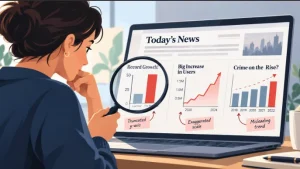
For most readers, though, the everyday power is simpler: read carefully, verify before you amplify, and reward outlets that show their workings. Every time you refuse to share something unverified, you take a small brick out of the machinery that spreads it.
A pocket version of everything above — the quick passes to run before you believe or share anything online.
Score a source, run the before-you-share triage, and make lateral reading a thirty-second reflex.
Open the source scorecard